How Long Does Coffee Stay Fresh After Roasting? (Real Timeline)
Coffee doesn’t “go bad” overnight — but it absolutely falls off faster than most people think. Freshness is flavor: aroma, sweetness, clarity, and (for espresso) crema. This guide gives you a real-world timeline for whole bean vs. ground coffee, plus simple storage rules that actually work.
If you want the full index of brewing guides + freshness basics, start here: Brew Lab.
The Short Answer: How Long Coffee Stays Fresh
-
Whole bean coffee: best flavor roughly days 4–21 after roast (often still enjoyable to ~30 days if stored well).
-
Ground coffee: best flavor is measured in minutes to hours, not weeks.
-
Espresso vs drip: espresso usually prefers a little more rest (degassing) than drip/pour-over.
| Coffee type |
“Best” window |
Still drinkable? |
| Whole bean |
Days 4–21 |
Often up to ~30+ days (quality fades) |
| Ground |
0–2 hours (best), same day (okay) |
A few days (flat + muted) |
Want the “roast date vs best-by date” breakdown (and what to avoid)? Coffee Roast Date Explained.
The Freshness Timeline by Day (Whole Bean)
Days 1–3: Degassing is loud
Freshly roasted coffee releases CO2. That gas can fight extraction — especially on espresso — which can show up as sourness, “gassy” aroma, fast channeling, or inconsistent shots. For drip, you can still brew early, but don’t be surprised if it tastes a little sharp or unsettled.
Days 4–14: Peak window for most brewers
This is where most coffees hit their stride: strong aroma, clear flavor notes, better sweetness, and more stable extraction. Espresso typically improves here because the puck behaves more predictably as degassing calms down.
Days 15–30: Flavor starts flattening
Still totally drinkable, but the “pop” fades: aromatics get quieter, sweetness drops, and everything tastes more generic. If you’re dialing espresso, you may notice thinner crema and a narrower “sweet spot.”
Days 30+: Muted, stale, or papery notes show up
Past a month, you’re usually in “works in a pinch” territory. You can still make coffee, but it’s less rewarding. Dark roasts often fall off faster than lighter roasts because the beans are more porous and oils oxidize sooner.
If you want the “whole bean vs ground” breakdown in more detail: How Long Coffee Stays Fresh (Whole Bean vs Ground).
What Degassing Is (and Why It Matters)
Roasting traps CO2 inside the bean. After roasting, that CO2 escapes. A little CO2 is good — it helps bloom and can support crema — but too much can block water from extracting evenly.
-
Too fresh (too much gas): sharp/sour cups, unstable espresso, weird channeling, big bloom but uneven flavor.
-
Too old (too little gas + more oxidation): flat aroma, dull sweetness, thin body, faster/looser espresso flow.
Signs Your Coffee Is Stale
| What you notice |
What it usually means |
| Weak aroma when you open the bag |
Volatile aromatics are gone (oxidation + time) |
| Flat, “generic coffee” taste |
Sweetness + clarity have dropped |
| Papery / cardboard / woody notes |
Classic “stale coffee” oxidation flavors |
| Espresso crema is thin and disappears fast |
Less CO2 + older oils |
| Bloom is weak or nonexistent (pour-over/drip) |
Coffee is older or was stored poorly |
Whole Bean vs Ground: The Part People Ignore
Grinding is the fastest way to make coffee stale. You’re taking a protected seed and turning it into thousands of exposed surfaces. Oxygen wins quickly.
-
If you care about flavor: buy whole bean, grind right before brewing.
-
If you buy ground: keep the bag sealed, use it fast, and accept that it’s a convenience trade.
Best Storage Practices to Extend Freshness
-
Airtight + opaque: keep oxygen and light out. (Clear jars on a bright counter are a freshness killer.)
-
Room temp, stable: store in a cool cabinet, away from the oven, dishwasher steam, and windows.
-
Dry: moisture wrecks beans and can add off flavors.
-
Avoid strong odors: coffee absorbs smells (spices, cleaning products, etc.).
-
Skip the fridge: humidity + odor transfer are real, and temperature swings add condensation risk.
Want the bigger “how to buy fresh coffee” playbook? Fresh Roasted Coffee: Why It Tastes Better + How to Buy It.
FAQ: Does Freezing Coffee Help?
Yes — if you do it correctly and you’re storing coffee longer than you’ll finish it fresh. Freezing slows oxidation, but moisture is the enemy.
-
Portion it: freeze in small, truly airtight bags/containers (one to two weeks per portion).
-
Don’t open/close a big container repeatedly: that’s how moisture gets in.
-
Grind from frozen: take a portion out, grind while still frozen, brew immediately.
-
Don’t refreeze: repeated thaw/freeze cycles accelerate staling and moisture damage.
Want Coffee That’s Actually Fresh?
The biggest “freshness hack” isn’t a gadget. It’s buying coffee that wasn’t sitting around for months. Here’s the plain-English comparison: Roasted-to-Order vs Grocery Store Coffee.
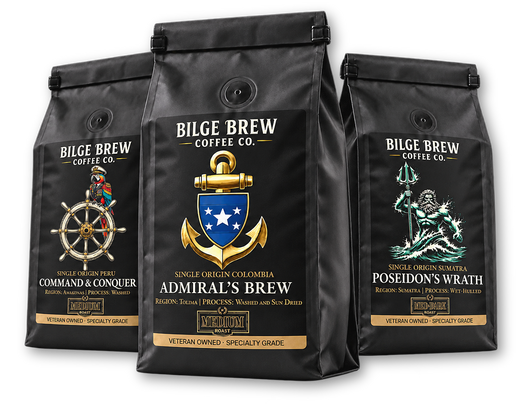
If you want a smooth, balanced daily driver that works across most brew methods, this is a solid pick: ADMIRAL’S BREW — Colombia Single Origin. Or browse all roasts here: Shop Coffee.
Quick FAQs
1) How long does coffee stay fresh after roasting?
Whole beans usually taste best within about 2–3 weeks of roasting (often peaking around days 4–21). Past that, flavor flattens faster — especially with poor storage.
2) How long does ground coffee stay fresh?
Ground coffee starts fading fast. Best flavor is within hours. Same-day is okay. Past a few days, it’s usually flat.
3) What is degassing and why does it matter?
Degassing is CO2 leaving the bean after roasting. Too much gas can cause uneven extraction; too little usually means the coffee is older and less aromatic.
4) What are the clearest signs coffee is stale?
Weak aroma, flat taste, papery notes, weak bloom, and thin/fast-fading crema (for espresso).
5) Should I store coffee in the fridge?
Usually no. Fridges add humidity + odor transfer and create condensation risk from temperature swings.
Nothing beats a strong cup of coffee for early mornings. For those who value more than just a caffeine jolt, a veteran owned coffee brand is worth a look. Enter Bilge Brew Coffee Co. — a Navy-themed delight crafted by those who know what it's like to burn the midnight oil.
Table of Contents
Best Coffee for Early Mornings
Starting your day with the right bean is crucial. If you're up before the sun, consider our SEA WITCH — French Dark Roast. It's bold, rich, and perfect for an eye-opening espresso. French dark roast coffee isn't just for aesthetics; it's a tried-and-tested friend for those needing a strong start.
Best Coffee for Night Shift Workers
Stalking through the night shift? We get it. The best coffee for night shift workers is roasted to order and packs energy into every cup. Bilge Brew’s ALL HANDS — Blonde Espresso Light Roast provides a lighter roast that tastes great and energizes when the clock strikes midnight.
How to Brew Espresso at Home
Brewing espresso at home doesn't need to be rocket science. Have you got a Moka pot? Excellent choice! It’s perfect for crafting deep shots without complicated gadgets. Pair your Moka pot espresso with our best espresso beans for a brilliant start — trust me.
Espresso Troubleshooting
Struggling with your espresso? Too sour or too bitter might mean you're grinding your beans too coarse or too fine. Our all roasts collection offers versatility that works with different brewing techniques. Tweak and find the grind that aligns with your taste.
Best Dark Roast for Espresso
When pondering over the best dark roast for espresso, look no further than French dark roast coffee. It's not just robust; it's a deep dive into flavor. Bilge Brew’s SEA WITCH is made for espresso lovers looking for intensity.
Best Coffee for Nurses and Firefighters
Nurses and firefighters need fuel for those grueling shifts. There's no one-size-fits-all answer, but small batch specialty coffee online is a good bet. Our MESS DECKS — Mexico Single Origin is great for those in service roles who deserve nothing but quality in their cup.
Single Origin vs Blend
Whether you opt for single-origin or blend depends on your preference. Single origins provide a clearer profile from a specific farm or region, like our DRUNKEN SAILOR — Guatemala Single Origin. Blends offer complexity, balancing flavors for a unique experience.
Feeling inspired to try something bold? Check our Single-Serve Cups (K-Cup® Compatible) for convenience and quality in every cup.
Grab your gear and get brewing! There's no better time to taste what a veteran owned coffee brand has to offer. Visit Bilge Brew Coffee Co. today to explore your next favorite roast.
Stay Sharp
Exclusive discountsNew Roasts. Better Coffee. First in Your Inbox.
Exclusive discounts, new drops, early access, and coffee worth knowing about. No spam. No drama.
⚓ You're in. First to know, first to brew.
No drama. Unsubscribe any time.