Best Coffee Beans for Espresso: What Actually Works
Here's something most espresso guides skip: the "espresso" label on a bag means almost nothing. It's a marketing decision, not a roast standard. Some of the best beans for espresso don't say "espresso" anywhere on the packaging — and plenty of bags that do say it are mediocre.
What matters is roast profile, freshness, and bean quality. Here's how to evaluate all three — and which Bilge Brew options are worth pulling shots with.
What Makes a Bean Good for Espresso
Espresso is a high-pressure, concentrated brew. Every variable gets amplified. A bean that tastes acceptable as drip can taste harsh, sour, or flat as espresso. Here's what to look for:
Roast Level
Most espresso drinkers land in the medium-dark to dark roast range — not because lighter roasts can't work, but because darker roasts are more forgiving to extract. The cell structure is more porous, water flows through more predictably, and the flavor profile (chocolate, caramel, roast notes) holds up under pressure.
Light roast espresso can be excellent — bright, sweet, distinct — but it requires a more precise grind, higher brew temperature, and a longer yield to pull without sourness. Not the starting point if you're still dialing in.
-
Medium-dark: balanced body, some sweetness, easier to dial
-
Dark: heavier body, bold flavor, narrow extraction window — grind slightly coarser than you think
-
Light: high ceiling, low margin for error — best once you have your setup locked
Freshness
This is the variable most people underestimate. Coffee is a perishable product. Ground coffee goes stale in days. Whole bean goes stale in weeks. Beans sitting in a grocery store warehouse for 6 months before hitting the shelf are already done before you buy them.
For espresso specifically, freshness affects crema directly. CO2 released from recently roasted beans is what produces crema. Stale beans = flat, thin crema = a sign the coffee is already past its peak. Roasted-to-order means beans are roasted after you order — not sitting on a shelf waiting. That difference is real and it shows in the cup.
Full breakdown: Roasted-to-Order vs Grocery Store Coffee.
Bean Quality (Specialty Grade)
Specialty grade means the beans scored 80+ on a 100-point scale for flavor, aroma, body, acidity, and defect count. Defects — fermented beans, insect damage, unripe cherries — taste like sourness, mustiness, or off-flavors. In drip coffee, these get diluted. In espresso, they get concentrated.
Commodity-grade beans are cheaper because they have more defects. That's fine for some applications. For espresso, where you're pulling a concentrated shot with no dilution, you feel every defect in the cup.
More on what this means practically: What Specialty Grade Coffee Actually Means.
Single Origin vs Blend for Espresso
Both work. They serve different goals.
Blends are designed for consistency. Different origins are combined to create a balanced profile that holds up across roast levels and brew ratios. Blends are more forgiving to dial in — they're built to be pulled as espresso.
Single origins are more expressive — one farm, one region, distinct character. A well-pulled single origin espresso can be exceptional. A poorly pulled one is sour, sharp, or hollow. Higher ceiling, less margin for error. Better once your setup is dialed.
Detailed comparison: Single Origin vs Blend.
Which Bilge Brew Beans to Use for Espresso
Anchor Espresso — Start Here
Purpose-built for espresso. Dark roast blend with a wide extraction window — forgiving to dial in, consistent shot to shot, dense crema. If you want one bag to pull shots on daily, this is it.
Anchor Espresso →
Red Alert — African Espresso Dark Roast
African-sourced dark roast built for espresso. More fruit-forward than Anchor — berry and dark chocolate notes. Pulls well as both straight espresso and in milk drinks where you want the coffee to cut through.
Red Alert →
Sea Witch — French Dark Roast
Pushed further than a standard dark roast — heavy body, intense roast-forward flavor, Arabica/Robusta blend. Works for espresso if you want maximum intensity. More unforgiving to extract than Anchor; grind slightly coarser and pull at a tighter ratio.
Sea Witch →
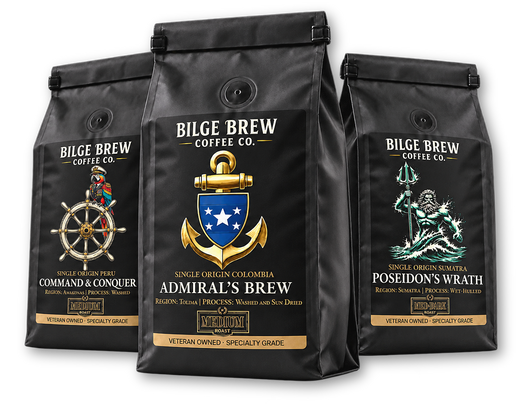
Poseidon's Wrath — Sumatra Single Origin Medium-Dark
Single origin Sumatra. Earthy, full-bodied, low acidity. Works well as espresso for people who want something different from a standard blend — distinct character, heavy body, less bright. Requires more precise dialing than a blend.
Poseidon's Wrath →
Patrol Roast — Honduras Single Origin
Light-medium single origin. Cleaner and brighter than the dark options. Pull it as a lungo or with a slightly higher temperature for clarity and sweetness. Best for experienced home baristas who want to explore origin-forward espresso.
Patrol Roast →
Want to compare styles? The Espresso Bundle is the fastest way to learn what you actually like. Browse the full Espresso Roasts collection.
Espresso at Home — What Actually Matters
Equipment matters less than people think. A decent grinder and a consistent recipe beat an expensive machine with stale beans every time. Here's the short version:
-
Use a scale. Dose in grams, yield in grams. Eyeballing dose is the fastest way to get inconsistent shots.
-
Grind fresh. Pre-ground espresso is usable but degrades fast. Whole bean ground right before brewing makes a noticeable difference.
-
Keep your grinder clean. Oil buildup and packed fines change how coffee flows through the burrs — silent saboteur. How to clean a coffee grinder.
-
Start with a 1:2 ratio in 25–30 seconds. 18g in, 36g out, 27 seconds. That's your baseline. Taste it, then adjust one thing at a time.
Full dialing-in guide: How to dial in espresso dose, yield, and time.
If shots keep coming out bitter: Why your espresso tastes bitter and how to fix it.
FAQs
Do I need beans labeled "espresso" to pull espresso?
No. "Espresso" on a bag is a suggestion, not a certification. Any whole bean coffee can be pulled as espresso. What matters is roast profile and freshness. Medium-dark and dark roasts are the most common starting point because they extract more predictably under pressure.
What roast is best for espresso?
Medium-dark to dark for most people — easier to dial, more forgiving, fuller body. Light roasts work well as espresso but require more precision. Start darker and work lighter as your skills improve.
How fresh does espresso need to be?
For best results, within 2–4 weeks of roast date for dark roasts, 1–3 weeks for lighter roasts. Too fresh (under 5–7 days) can cause channeling from excess CO2. Too old and crema suffers, flavor goes flat. Roasted-to-order means you're in the right window when it arrives.
What's the best Bilge Brew bean for a beginner espresso setup?
Anchor Espresso. Wide extraction window, consistent, built for daily shots. Once you have your setup dialed on that, branch out to single origins or the Espresso Bundle to compare.
Are single-serve cups good for espresso?
Convenient but not the same. Single-serve cups use pre-ground coffee in a sealed pod — practical for fast brewing, but you lose control over grind size and freshness. If you want espresso character from a single-serve setup, use the smallest cup size and preheat your mug. Options: Single-Serve Cups collection.
Stay Sharp
New Roasts. Better Coffee. First in Your Inbox.
Exclusive discounts, new drops, early access, and coffee worth knowing about. No spam. No drama.
⚓ You're in. First to know, first to brew.
No drama. Unsubscribe any time.