Best Coffee for Moka Pot: How to Make Strong Coffee Without Burning It
The best coffee for moka pot brewing is fresh, medium-fine ground coffee with enough body to handle stovetop pressure without turning harsh. Dark roast, medium-dark roast, and espresso-style roasts usually work best because moka pots make concentrated coffee. The trick is simple: use the right grind, do not tamp the grounds, keep the heat controlled, and remove the pot before it starts angrily sputtering.
Most likely reasons your moka pot coffee tastes bad
If your moka pot coffee tastes bitter, weak, burnt, or sour, it is usually one of these:
- Grind is too fine or too coarse
- Heat is too high
- Coffee is packed down too tightly
- Pot is left on the stove too long
- Coffee is stale
- Water level is too high
- Moka pot is dirty or the gasket is worn out
- Wrong roast for your taste
Moka pot coffee should be strong. It should not taste scorched, metallic, or like something you brewed out of spite.
What is a moka pot?
A moka pot is a stovetop coffee maker that pushes hot water through ground coffee using steam pressure. It makes a strong, concentrated cup that feels closer to espresso than regular drip coffee.
But it is not true espresso. Espresso machines use much higher pressure. A moka pot gives you a bold, heavy cup without needing a full espresso setup.
That is why the moka pot is useful. It is cheap, simple, compact, and strong enough for people who think drip coffee tastes too weak.
Best coffee for moka pot brewing
The best coffee for moka pot brewing usually has three traits:
-
Freshness: Stale coffee tastes flat and bitter faster in a moka pot.
-
Body: Moka brewing favors coffee that can handle concentration.
-
Controlled roast level: Too light can taste sharp. Too dark can taste burnt if you overheat it.
For most people, a medium-dark roast, dark roast, or espresso roast is the safest starting point.
If you want one strong Bilge Brew starting point, use Anchor Espresso. It is the most obvious fit if you want moka pot coffee that tastes bold and holds up black or with milk.
If you want something heavy but not locked into espresso roast, browse Bilge Brew’s all roasts collection and look at the darker side of the lineup.
Best Bilge Brew picks for moka pot coffee
1. Anchor Espresso — Best overall moka pot pick
Anchor Espresso is the best starting point for moka pot drinkers who want a strong, classic cup. It makes sense for people who like dark roast, espresso-style coffee, moka pot lattes, café cubano-style drinks, or strong black coffee.
Choose Anchor Espresso if:
- You want bold moka pot coffee.
- Your current coffee tastes weak.
- You add milk and need the coffee to still show up.
- You want something closer to espresso without buying an espresso machine.
Mid-article CTA: Start with Anchor Espresso for your moka pot.
2. Bilgewater — Best medium-dark single origin option
Bilgewater is a good fit if you want a medium-dark coffee that still has weight but does not go as dark as a full espresso roast.
Choose Bilgewater if:
- You want moka pot coffee with a deeper profile.
- You like medium-dark coffee more than straight dark roast.
- You drink coffee black and want body without going too harsh.
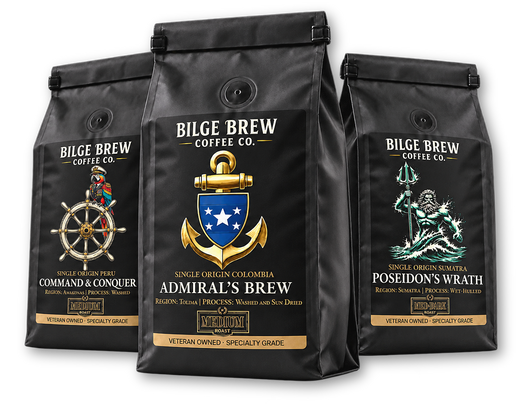
3. Poseidon’s Wrath — Best if you like heavier single origin coffee
Poseidon’s Wrath is a better fit for people who like bolder, earthier, heavier coffee. Moka pots can bring out intensity fast, so this is for drinkers who actually want a stronger profile.
Choose Poseidon’s Wrath if:
- You like Sumatra-style depth.
- You want a heavier cup.
- You do not want bright or delicate coffee in your moka pot.
4. Sea Witch — Best for dark roast drinkers
Sea Witch is the pick if you already know you like French dark roast. Use controlled heat with this one. Dark roasts can taste great in a moka pot, but they can also turn bitter fast if you blast them over high heat.
Choose Sea Witch if:
- You like dark roast.
- You want a heavier cup.
- You usually add milk or cream.
- You want intensity more than brightness.
How to make moka pot coffee without burning it
Moka pot coffee goes bad when people treat the stove like a race. High heat is how you get burnt, bitter coffee.
Use this method:
-
Add hot water to the bottom chamber. Fill to just below the safety valve. Do not cover the valve.
-
Add medium-fine ground coffee to the basket. Fill it level, but do not pack it down.
-
Level the grounds gently. No hard tamping. This is not an espresso machine.
-
Assemble the moka pot carefully. Use a towel if the bottom chamber is hot.
-
Use low to medium heat. Do not crank the burner.
-
Watch the flow. Coffee should come out steadily, not violently.
-
Remove it before loud sputtering. Once the stream turns pale and starts sputtering, get it off the heat.
-
Pour it out. Do not leave brewed coffee sitting in hot metal.
If your moka pot screams, spits, and smells burnt, that is not “authentic.” That is bad heat control.
Moka pot grind size: what you actually need
Moka pot coffee needs a grind finer than drip coffee but usually coarser than espresso. Think medium-fine.
If the grind is too coarse, the coffee will taste weak, thin, and under-extracted.
If the grind is too fine, the moka pot may clog, brew too slowly, or taste harsh and bitter.
Use this simple guide:
-
Weak and watery: Grind a little finer.
-
Bitter and harsh: Grind a little coarser or lower the heat.
-
Slow and sputtering: Grind coarser and check that you did not pack the basket.
-
Sour or sharp: Grind slightly finer or use a darker roast.
Change one thing at a time. If you change grind, heat, water level, and coffee at once, you will not know what fixed the cup.
Should you tamp moka pot coffee?
No. Do not tamp moka pot coffee like espresso.
Fill the basket, level the grounds, and leave it alone. Packing the coffee down can restrict flow, create too much pressure, and make the coffee taste bitter or uneven.
This is one of the most common moka pot mistakes. People see espresso videos, then start treating the moka pot like a tiny espresso machine. It is not.
Why your moka pot coffee tastes bitter
Bitter moka pot coffee usually comes from too much heat, too fine a grind, stale coffee, or leaving the pot on the burner too long.
Fix it this way:
- Use lower heat.
- Remove the pot before aggressive sputtering.
- Try a slightly coarser grind.
- Do not tamp the grounds.
- Clean old coffee oils from the pot.
- Try a medium-dark roast if dark roast tastes too harsh.
Do not confuse burnt with strong. Strong coffee has body. Burnt coffee tastes like you lost an argument with your stove.
Why your moka pot coffee tastes weak
Weak moka pot coffee usually means the grind is too coarse, the coffee is stale, the basket is underfilled, or the heat is causing a bad extraction.
Fix weak moka pot coffee this way:
- Use a medium-fine grind.
- Fill the basket level without packing it.
- Use fresh coffee.
- Use a bolder roast like Anchor Espresso.
- Make sure the gasket is sealing properly.
If your moka pot coffee tastes like watered-down drip coffee, something is wrong. A moka pot should make concentrated coffee.
Why your moka pot coffee tastes sour
Sour moka pot coffee usually means under-extraction or a roast that is too bright for your taste.
Fix it this way:
- Grind slightly finer.
- Use a medium-dark or dark roast.
- Make sure the brew does not rush too quickly.
- Use enough coffee in the basket.
- Try Bilgewater or Anchor Espresso instead of a lighter roast.
Light roasts can work in a moka pot, but they are less forgiving. If you are not trying to turn breakfast into a calibration exercise, start darker.
Moka pot vs espresso: what is the difference?
Moka pot coffee is strong and concentrated, but it is not real espresso.
Here is the practical difference:
-
Espresso machine: Uses high pressure, fine grind, and short extraction.
-
Moka pot: Uses steam pressure from stovetop heat and makes concentrated coffee.
-
French press: Uses steeping and produces a heavier, less concentrated cup.
-
Drip coffee: Uses gravity and usually produces a lighter cup.
So no, a moka pot will not replace a real espresso machine if you care about true espresso. But it can make strong coffee at home without expensive gear. That is enough for a lot of people.
Best moka pot setup for early mornings and night shifts
The moka pot works well when you need strong coffee without a complicated setup. That makes it useful for early mornings, night shifts, long workdays, and people who do not want weak coffee before leaving the house.
Use this simple setup:
-
Before work: Brew with Anchor Espresso or another medium-dark roast.
-
For travel: Pour it into an insulated tumbler immediately.
-
For milk drinks: Use Anchor Espresso, Sea Witch, or another bold roast.
-
For black coffee: Try Bilgewater or Poseidon’s Wrath if you want body without making the cup too sharp.
A moka pot is not fancy. That is the point. It makes strong coffee with basic gear.
FAQ: Best coffee for moka pot
What coffee is best for a moka pot?
The best coffee for a moka pot is fresh medium-fine ground coffee with enough body to handle concentrated brewing. Medium-dark, dark, and espresso-style roasts usually work best.
Can I use espresso beans in a moka pot?
Yes. Espresso beans can work well in a moka pot. Use a medium-fine grind, not a true espresso grind, and do not tamp the grounds.
Is moka pot coffee the same as espresso?
No. Moka pot coffee is strong and concentrated, but it does not use the same pressure as an espresso machine. It is espresso-like, not true espresso.
Why does my moka pot coffee taste burnt?
Burnt moka pot coffee usually comes from too much heat or leaving the pot on the stove too long. Use lower heat and remove the pot before aggressive sputtering.
Why is my moka pot coffee weak?
Weak moka pot coffee usually means the grind is too coarse, the basket is underfilled, the coffee is stale, or the pot is not sealing properly.
Should I use whole bean or ground coffee for moka pot?
Whole bean is better if you have a grinder because you can dial in the medium-fine grind. Ground coffee is fine for convenience if it is ground appropriately for moka pot brewing.
Final take: the moka pot is simple, but it is not idiot-proof
A moka pot can make strong, full coffee at home without an espresso machine. But it will punish bad habits fast. Too much heat, the wrong grind, stale coffee, or packed grounds can turn a good idea into burnt sludge.
Start with fresh coffee, a medium-fine grind, low to medium heat, and the right roast.
If you want the safest Bilge Brew starting point, get Anchor Espresso. If you want to compare darker and medium-dark options, browse Bilge Brew’s all roasts collection.
Final CTA: Get Anchor Espresso for stronger moka pot coffee.
# Suggested image ideas with alt text
1. Image: Moka pot brewing on a stovetop beside an Anchor Espresso bag
Alt text: Anchor Espresso coffee brewing in a moka pot on the stove
2. Image: Medium-fine ground coffee in a moka pot basket before brewing
Alt text: Medium-fine coffee grind for moka pot brewing
3. Image: Moka pot coffee pouring into a black mug
Alt text: Strong moka pot coffee poured into a black coffee mug
4. Image: Bilge Brew Anchor Espresso and Bilgewater bags beside a moka pot
Alt text: Bilge Brew coffee options for moka pot brewing
5. Image: Moka pot coffee in a travel tumbler for work
Alt text: Strong moka pot coffee prepared for an early morning or night shift
# Suggested internal links and anchor text
1. https://bilgebrew.com/products/anchor-espresso
Anchor text: Anchor Espresso
2. https://bilgebrew.com/products/bilgewater-medium-roast
Anchor text: Bilgewater
3. https://bilgebrew.com/products/poseidons-wrath-sumatra-single-origin-medium-dark-roast
Anchor text: Poseidon’s Wrath
4. https://bilgebrew.com/products/sea-witch-french-dark-roast
Anchor text: Sea Witch
5. https://bilgebrew.com/collections/all-roasts
Anchor text: Bilge Brew’s all roasts collection
6. Suggested related blog when available: /blogs/bilge-brew/espresso-troubleshooting-sour-bitter-weak-shots
Anchor text: espresso troubleshooting guide
7. Suggested related blog when available: /blogs/bilge-brew/how-to-make-strong-coffee-at-home
Anchor text: how to make strong coffee at home
8. Suggested related blog when available: /blogs/bilge-brew/why-your-coffee-tastes-bitter
Anchor text: why your coffee tastes bitter
# Suggested schema types
1. BlogPosting or Article schema for the full article
2. FAQPage schema for the FAQ section
3. HowTo schema may be appropriate because the article includes step-by-step moka pot brewing instructions
4. Product schema should stay on individual Bilge Brew product pages, not this blog post
# Final quality checklist
1. Answers the main query within the first 100 words: Pass
2. Based on a buyer problem, not generic moka pot trivia: Pass
3. Clear path from problem to fix to product: Pass
4. Product recommendations are natural and specific: Pass
5. CTA is visible and purchase-oriented: Pass
6. Avoids generic coffee clichés: Pass
7. Avoids fake claims, fake proof, and invented statistics: Pass
8. Sounds like Bilge Brew, not a polished specialty coffee brochure: Pass
9. Advice is practical for a normal moka pot user: Pass
10. Internal links included with clear anchor text: Pass
11. Useful even if the reader does not buy immediately: Pass
12. Fluff removed: Pass