If your coffee tastes weak or watery, check how much coffee you use before changing beans. For drip, pour-over, or French press, try 30 grams of coffee with 480 grams of brewing water as a starting recipe. If the result tastes pleasant but diluted, try 32 grams of coffee with the same water next time. If it is thin and sharply sour, check the grind and how evenly the grounds get wet.
What does “watery” tell you?
Strength is the concentration of dissolved coffee in your drink. Extraction is how much material the water removes from the grounds. They are related, but they are different measurements. That is why making coffee taste more intense and correcting an unpleasant flavor can require different adjustments.
-
Faint flavor, otherwise pleasant: start with the coffee-to-water ratio.
-
Thin and sharply sour: after checking the ratio, look for insufficient or uneven extraction. The sour-coffee troubleshooting guide covers that diagnosis in more detail.
-
Watery and bitter: do not automatically grind finer or brew longer. Check for uneven brewing, a stalled filter, or a roast profile you dislike.
These are clues, not definitive diagnoses. Coffee research shows that flavor depends on the interaction of strength, extraction, and the coffee itself, rather than a simple “sour means under-extracted, bitter means over-extracted” rule.
1. Weigh the coffee and brewing water
A 1:16 ratio means 1 gram of dry coffee for every 16 grams of water you put into the brewer. A 1:15 ratio uses slightly more coffee for the same water. Both are practical starting points for this troubleshooting exercise, not universal definitions of a good cup.
Starting recipes for drip, pour-over, and French press
| Brewing water |
Coffee at 1:16 |
Coffee at 1:15 |
| 240 g |
15 g |
16 g |
| 480 g |
30 g |
32 g |
| 720 g |
45 g |
48 g |
| 960 g |
60 g |
64 g |
The water column measures water going in, not the finished drink. Some water stays in the grounds. For this purpose, 480 grams of water is approximately 480 milliliters. These are not espresso recipes or cold-brew concentrate ratios.
For example, 20 grams of coffee with 480 grams of water is a 1:24 recipe. Moving to 30 grams with that same water gives you a 1:16 recipe. That is a more useful first experiment than buying a darker roast and repeating the same dilute recipe.
Use a scale instead of guessing with heaped scoops. Do not assume a “cup” marked on your brewer equals your drinking mug. Stay within the manufacturer's basket capacity and recommended batch sizes. If more grounds would overfill the basket, reduce the water only within the brewer's supported range.
2. Adjust the grind after the ratio
If the measured recipe still produces thin, sour coffee, try a small step finer while keeping the coffee dose and water amount unchanged. A finer grind can help extraction, but pushing it too far can restrict flow. Stop and reassess if a filter brew begins to stall or tastes increasingly harsh.
Use your grinder or brewer's suggested setting as a starting point. “Medium” is not an identical setting across grinders. For pour-over, keep your pouring pattern consistent while adjusting grind so you can tell what helped. If you buy pre-ground coffee, work on the ratio and brewer setup first; you cannot adjust the grind in that bag.
3. Check what happens during brewing
Drip coffee and pour-over
A measured recipe still needs water to reach the coffee properly.
- Seat the correct filter and basket securely. Check that the paper has not folded over and allowed water to miss the grounds.
- Level the grounds before starting. For pour-over, wet the entire bed during the initial pour and avoid directing most of the water down the bare filter wall.
- Empty any filter-rinse water from the carafe before brewing.
- Use the appropriate full-batch or smaller-batch setting, if your machine has one, and let the cycle finish before judging the result.
There is no universal two-to-three-minute target for automatic drip coffee. For example, Moccamaster's KB instructions describe a roughly four-to-six-minute brew. Use your own machine's guidance; a pour-over recipe's timing does not automatically apply to a full pot.
French press
Start with coarse grounds, the measured ratio above, and about four minutes of contact time. Gently stir to wet the grounds thoroughly, then follow your press's instructions for plunging and pouring. If the cup is still thin and sour, try a slightly finer grind on the next brew while keeping the time and ratio unchanged. A longer steep is another possible adjustment, but test it separately.
4. Check heat, water, and storage
For manual hot brewing, around 200°F / 93°C is a useful starting temperature. The commonly cited 195–205°F / 90–96°C range is guidance, not a boundary where water suddenly burns coffee. Baratza's V60 recipe, for example, starts at 210°F / 98°C. Follow the recipe for your method and adjust based on taste.
If a familiar machine suddenly brews differently, check its cleaning and descaling instructions before blaming the beans. Use water that tastes pleasant on its own and meets the machine's requirements. A filter may help a chlorine taste, but “filtered” does not automatically mean suitable for every brewer.
If the aroma has faded and the coffee tastes flat at a measured ratio, consider how it has been stored. Keep it sealed against air, away from heat, light, and moisture. Grind only what you need when practical. Adding more old grounds will not restore aromas that have already been lost.
Choose the roast for its flavor
Once the recipe works, choose a coffee whose flavor you actually want. Darker roast character and beverage concentration are different things. A dark roast can still make a diluted cup.
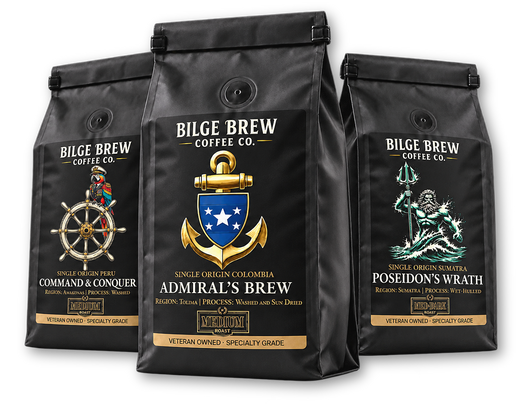
If you prefer dark-chocolate and toasted-sugar notes with mild smoke, General Quarters is Bilge Brew's medium-dark blend. It is available as whole bean or ground for drip. Choose whole bean if you want control over the grind for your press or pour-over.
For a first order, a 12 oz bag lets you try the profile before committing to a larger size. Brew it with a measured recipe and change one variable at a time.
Choose General Quarters in a 12 oz bag
Questions about weak coffee
Can I strengthen coffee after it is brewed?
You can blend in separately brewed espresso or a more concentrated batch, although that changes the flavor too. Reheating alone does not correct the recipe. For a repeatable fix, measure the next batch and adjust the coffee-to-water ratio.
Why does my coffee taste fine hot but watery over ice?
Melting ice adds water. A normal hot-coffee recipe poured over a large amount of ice can become diluted. Use an iced-coffee recipe that accounts for ice as part of the total water, rather than treating it as an extra ingredient that has no effect on strength.
By Nathan Janusz, owner of Bilge Brew Coffee Co., U.S. Navy veteran, and registered nurse.
Sources and brewing references